Lanzarote is the fourth largest island, in the Canary Island archipelago, which sits just off the coast of Morocco but in fact belongs to Spain. With its stunning volcanic landscape and moon like features, this island is home to endless unique adventures and things to do, way beyond the comfort of your hotel room.
I may be biased as I have been coming to this island every single year of my life, and my parents now live here, but Lanzarote is Europe’s coolest and most underrated island. In 2023 I introduced Lanzarote to Harry too. Moreover, we now both spend multiple months every year on this paradise island. Which brings us to writing this guide for you to become acquainted with Lanzarote and also have the opportunity to experience all the incredible wonders, this little island in the Atlantic has to offer.
This guide will highlight the best places to visit in Lanzarote including the classic spots, as well as some off the beaten path gems, that only locals really know about.
The best time to visit Lanzarote
Lanzarote is often referred to as ‘The Island of Eternal Spring’ as it is fortunate enough to have year-round warm and dry weather. This makes choosing a time to visit much easier for you. There are a few months of the year that we think are the best time to be here, these are: April – May and September – October. During these months you will likely experience warm days (average of 25-30 degrees Celsius) and then cooler but still mild evenings.
Winter (January – February) is also a great time to visit if you want to escape the cold in Northern Europe, we tend to spend all of January here as it is the worst month to be further north, in our opinion. You will be guaranteed to receive some winter sun during the day (average of 20 degrees Celsius) but note that evenings are much cooler and there is more chance of rainfall during these months.
Summer (June – August) can be very hot, temperatures rise above the 30-degree Celsius mark, and this is also the peak season on the island. We try to avoid these months as best as possible, because you are likely to experience more crowds with these months falling over European school holidays too.
How to reach Lanzarote and get around
Lanzarote is easily reached from many European cities and by most European airline carriers such as: Ryanair, Easy Jet, Jet2, TUI and Vueling. We often find the most affordable flights out of major cities such as, London with Ryanair. If you want to secure the best price, then make sure you book well in advance (especially if you plan to visit in the summer). Or maybe consider visiting in the low season. We have bagged flights to Lanzarote before for as little as £15 one way.
Once you are on the island, we highly recommend that you rent a car. This is without a doubt the best way to explore Lanzarote at your own pace, giving you the freedom to reach all of the places mentioned below. There are a lot of rental companies available on the island, however, we only ever use Autoreisen as they always offer the lowest price, require no deposit and do not charge for an additional driver. In the low season, you can find car rentals through them for as little as 10 Euros per day.
The best places to visit in Lanzarote
1. Timanfaya National Park
Let’s start with the most famous and popular tourist attraction on the island. If you are a first-time visitor, it is still absolutely worth visiting. The entry fee is 12 Euro per adult and 6 Euro per child. You can purchase a CACT ticket that includes multiple centres, which may save you money, you can find it here.
To understand the island, you must first understand that it was formed due to historical volcanic activity, more specifically from 1730-1736 there were constant eruptions on the island. Today Timanfaya National Park is home to 25 volcanoes, one of which remains active.
Once you arrive at the main parking area, you’ll be directed to get on a bus which will take you through the park. Please note, that this is the only way to visit the main area of Timanfaya National Park due to the environment being incredibly unique and fragile, it must be preserved so general traffic and walking is not permitted in the heart of the park.
Once on the bus, it will take you through the park, driving through a volcanic desert and alongside craters. There will be opportunity to stop along the way to take photos, so don’t worry! Once you return to the visitor centre, hang around to watch the display of geysers and fire that showcases just how hot the earth is under your feet.

2. Monumento Natural de Los Ajaches
Looking for a beach day? Luckily, you’re on an island so there’s no shortage of them. But with endless beaches to choose from, it’s hard to know where to start. Monumento Natural de Los Ajaches is a protected area at the southern tip of Lanzarote, that is home to some of the island’s most pristine beaches. Playa de Papagayo being the most famous and most visited, it boasts a sheltered cove with crystal clear waters to enjoy.
Whilst Papagayo is undoubtedly beautiful, it does get a little busy! Therefore, our favourite beach is actually right next to Papagayo, only a short walk away across the cliffs you will find Playa del Pozo. At low tide this beach reveals a collection of perfectly shimmering rock pools to bathe in. It also as a very dramatic backdrop, as you can see the mountains from here off in the distance. This beach is much quieter and perfect if you want a natural and peaceful beach day.
To reach the beaches within the reserve you will have to drive along a dirt road for the last few miles. It isn’t the worst road in the world, but it’s certainly not a pleasant drive, so remember to take it slow. About halfway down the track, you’ll come to a check point where you’ll be required to pay 3 euros per vehicle to enter the reserve. This is a conservation fee, required of all visitors to maintain the beauty of the area.
As you approach the coast there are signs directing you to each beach and there are a couple of gravel car parks to park in. It doesn’t really matter where you park as it’s only a short walk between each beach. At Papagayo you will find a restaurant up on the cliffs, this is a great spot for some sundowner drinks, although again it does get busy and in summer you may have to queue for a seat.
Don’t forget to bring your snorkel, the waters surrounding the beaches are teeming with marine life and the water is crystal clear, making it one of the best spots on the island to snorkel or dive.

3. La Geria Region
Did you know that Lanzarote has its very own wine region, known as La Geria. It is home to some of the most unique varieties of wine, and due to the volcanic geology of the island, the wine has a very distinctive taste. A trip to La Geria is guaranteed to be like no other vineyard experience you have been on before. The landscape is covered in black volcanic sand and dotted with individual vines, sheltered by small, curved stone walls, to protect from the strong winds that Lanzarote faces.
One of the easiest ways to visit La Geria is through an organised tour, which is a great option for if there’s a group of you and no one is willing to be designated driver. The guided tours can start anywhere in the region of 30 euros per person and usually include a specified number of tastings. We have joined this TUI tour before and would highly recommend it, as you stop in the region but also many more of the places mentioned in this guide.
If you do rent a car and have someone willing to drive you around, then we think that a self-drive tour is a much better option, as it gives you all the time in the world to explore the region and multiple vineyards. A third option is to take a taxi to and from La Geria. The region is only a 20-minute drive from popular resorts such as Playa Blanca and Puerto Del Carmen and a 30-minute drive from Costa Teguise.
Our top 3 Bodega recommendations:
- Bodega’s Rubicon – Tasting’s cost 2 euros per wine.
- Bodega’s Antonio Suarez – Small family owned, tasting’s costs 1 euro per wine.
- Bodega La Geria – Tastings cost 2-3 euros per wine.
- Bodegas Stravs– Tastings cost 3-4 euros per wine.

4. Cesar Manrique Foundation
You will learn a lot about Cesar Manrique if you visit some of the other places also mentioned in this guide. However, the foundation is the epicentre of Cesar Manrique’s work and story. There is an entry fee of 10 Euro per adult and 3 Euro per child.
Manrique was an artist, sculptor, architect and nature activist. Who was born on the island and lived a rather extraordinary life. Much of his work went into campaigning for the conservation of Lanzarote’s unique and natural beauty. Unlike the neighbouring Canary Islands, you’ll notice that Lanzarote’s buildings and architecture is what makes the island stand out. There is a law on the island that a building cannot be built above three levels, that was introduced by Manrique. Furthermore, the whitewashed walls and green or blue window frames were also designed by Manrique, in a way that is supposed to integrate seamlessly with the island’s natural surroundings.
At the foundation you will get the chance to visit one of his properties, a home he lived in for 20 years. That has been carved out of the volcanic landscape and built underground, inside a lava field. It is such an experience to enjoy this extraordinary place and learn more about the history of Lanzarote and how the role that Cesar Manrique had in the island’s story.
If you are an art and architecture fan or just curious by the quirky, then this is a must visit spot for you!

5. Teguise
The inland town of Teguise was once the capital on Lanzarote, before it was moved to Arrecife. Today, Teguise is one of the island’s most charming towns. Offering visitors and insight into the slow and carefree Canarian way of life. What’s more, every Sunday 9am-2pm, a huge market is held in the town square.
At the market, you can find everything from souvenirs and clothes to artwork and trinkets, there are even stalls serving food and drink. Plus, many cafes and shops in the town will open their doors. Even if you don’t want to buy anything, we highly recommend visiting just for the atmosphere of an island market, its magic. Plus, the town is extremely picturesque with stunning views over the island and out to the ocean on both sides.
However, if you do fancy a little treat, then we recommend that you stop by the baked goods stand at the market. They have the most delicious cinnamon rolls we have ever tasted! We often pop down on a Sunday morning just for them and never regret it.
It is best to arrive in Teguise early, around 9am when it all kicks off. Even if you don’t have a car you can still reach Teguise via public transport. This is the most inexpensive way to get there but definitely leave early as the buses do fill up quickly, it’s the place to be on a Sunday morning. The buses run from most major resort towns; you can find the timetables here to plan your journey.

6. El Bosquecillo
If you only have time to visit one viewpoint, be sure to make it this one and then thank us later. Despite this spot gaining popularity over the years, it is still a beautiful and remote gem that will leave you in awe. The only way to access this viewpoint is by having your own vehicle, if you type El Bosquecillo into Google maps it will take you right there.
Be aware that parking is limited, especially around sunset as this is the busiest time of day. We suggest that you park at the bottom of the road leading to the viewpoint and walk 10 minutes to the cliff edge. The road is not well maintained and especially after heavy rainfall it can become impassable.
Hidden away in the hills of Lanzarote, just outside of the village of Haria. El Bosquecillo offers panoramic views from the top of the Risco de Famara and out to Playa de Famara and the surrounding volcanoes below. It is truly the most breath-taking view and the place to be for sunset.
There are a few spots to sit down on the wall and admire the view in front of you, we often take a beer up here to enjoy the sunset with. Please take caution when on the cliff side, especially during high winds. There are no barriers and people have fallen off the edge in recent years.

7. Playa de Janubio
What makes Lanzarote so unique is that it’s one of the few places within Europe, that you can find black sand beaches. It’s hard to say how many there are on the island, but we think this is the best and most accessible.
Playa de Janubio is situated in the South of the island, right next to Timanfaya National Park. Meaning you could definitely combine a visit to this beach, with a visit to the park. It is the perfect place to enjoy some raw beauty on a hot day, as the black sand will for sure warm you up quickly, after a dip in the cold Atlantic Ocean.
There are no facilities on the beach, so bear that in mind when choosing to visit. Despite this you are only 15 minutes from Playa Blanca. This is a truly wonderful and dramatic beach, the contrast of the ocean against the black sand is just mesmerising. It is especially great if you own a drone and can shoot some photos like the one below.

8. Jameos Del Agua
This is probably our favourite paid attraction in Lanzarote. It is a world away from the busy resorts and offers visitors some peace and tranquillity. The entry fee is 10 Euro per adult and 5 Euro per child. But it is part of the CACT group, you can buy a pass for multiple centres which may save you money, find it here.
Another one of Cesar Manrique’s creations, Jameos Del Agua is a beautiful art installation, that has been created with nature inter woven within it. You’ll start by descending into a volcanic tunnel, where at the bottom of the cave there is a lake full of small white crabs, that you will only find here on the island. The atmosphere with the most peaceful music playing, would make anyone feel instantly calm.
Once you come out of the cave you are then greeted by a beautiful pool, made in the typical Lanzarote style. This area is an oasis and is the most idyllic place to stop and sit in the sun for a while, whilst you admire the beauty around you. Note that swimming is not permitted in the pool, although that hasn’t stopped people in the past!
There is also a cafe and gift shop on site. There used to be a museum here too, which is currently undergoing renovation. This is my favourite museum on the whole island, as it explains more about the volcanic formation of Lanzarote and the other Canary Islands, which is rather fascinating.

9. Arrieta and Punta Mujeres
If you are tired of the resort towns and want to escape for the day. Or perhaps you’re looking for somewhere a little more local and quieter to base yourselves, then look no further than Arrieta and Punta Mujeres. These two tiny fishing villages on the Northeast coast of the island are everything you’ll need for an authentic island experience.
We have stayed in Arrieta before and often visit Punta Mujeres and they are both very charming. There are plenty of local restaurants to choose from, serving mostly fish as that is the main produce here. However, be aware that in low and shoulder seasons the restaurants will likely shut at around 6/7pm as it’s that quiet! We can recommend this cafe for a delicious and ridiculously cheap lunch with an ocean view.
Arrieta is also popular with surfers, ‘Playa de la Garita‘ offers perfect conditions when the wind and waves are playing ball. It is also a lovely beach for relaxing and swimming in the ocean. Further along the coast in Punta Mujeres, this village has a selection of tidal pools along its coast, which make for a perfect spot to swim if you aren’t a fan of the deep ocean.

10. La Graciosa Island
Although technically not Lanzarote, as it is a separate island, La Graciosa can only be reached from the port of Orzola at the northern tip of Lanzarote. Taking the ferry across to La Graciosa makes for a great day trip from Lanzarote and offers a change in scenery. Ferry tickets cost 28 Euros return per adult and 15 Euros return per child, you can book tickets here. Or at the Lineas Romero office at Orzola port.
We won’t dive too deep into La Graciosa Island in this post as it deserves a post of its own. However, we will say that it is totally worth visiting. It is a very remote island and is one of the last places in Europe yet to receive tarmacked roads, as all the roads are sand. A visit here will give you an off the beaten path adventure, literally!
The landscape on La Graciosa is wild, rugged and rocky. There are many hidden beaches to explore, such as Playa de las Conchas, as well as some great hiking. The best way to get around the island is to hire bikes from the main village for only 10 Euro per bike, we can recommend this bike shop.

11. Caleton Blanco
Located in the North of the Lanzarote just outside of the small village of Orzola, you’ll find this beautiful lagoon. Protected from the immensely strong waves of the Atlantic Ocean, the waters here are calm and crystal clear, teeming with marine wildlife.
As it can get quite windy in Lanzarote and especially in the North. There are wind shelters that have been built out of the volcanic rocks on the beach. These shelters provide the perfect sanctuary away from the winds and are the ultimate sunbathing spot on a hot day. This beach is always fairly quiet, as it’s quite far from all of the resorts.

12. Mirador del Rio and Guinate
Mirador del Rio is a paid attraction, with a fantastic view onto La Graciosa Island. It is another creation of Cesar Manrique and features a rather aesthetic cafe area alongside the viewpoint that takes you to multiple levels. There is a small fee of 5 Euros per adult and 2.50 Euros per child. It’s a small price to pay for these magnificent views. Again, it’s included in the CACT multi centre ticket, that you can find here.
As you approach Mirador del Rio there is another free viewpoint nearby, that we think is equally as beautiful. This viewpoint is called Mirador de Guinate, it is here that you will get an even better perspective on the cliffs below you and the bright blue ocean below.

13. Montana de Tinaguache
If you enjoy a hike, we’ve got you covered! Even if you aren’t much of a hiker, this one is still for you because it’s an easy one. Located approximately 3.5km outside of the resort town of Costa Teguise, you can access Montana de Tinaguache, by driving to the base of the volcano. Or by walking from the centre of town, which will take you approximately 40 minutes and it is mostly flat the entire way to the base.
It will only take roughly 30 minutes to summit the volcano. Although it is a steep climb and you may be on your hands and knees for part of it. The ground is loose so wear suitable footwear. Once you reach the top, the views are just incredible, as you’ll be able see across the island from East to West and be rewarded with views over the surrounding volcanoes in the distance.
From here you will understand why Lanzarote has been used as a film set for many sci-fi movies.

14. Cueva de los Verdes
If you are the type of person who likes to head underground in search of other worldly wonders, then you will love Cueva de los Verdes. This isn’t just any old cave; it was formed by an underground lava river millions of years ago. The lava river came from the nearby La Corona volcano, that you will also find in this list. Entry fees to the cave are 10 Euro per adult and 5 Euro per child.
The cave itself is pretty impressive, and you will be shown through it on a guided tour in multiple languages. There are a lot of stairs, and it can get quite tight in some parts where you’ll have to duck your head. Therefore, if you aren’t comfortable with that, then it’s best not to skip this one.
Towards the end there is a surprise waiting for you, but you’ll just have to go to find out what that is yourself!

15. Las Grietas
Lanzarote is full of unique rock formations after millennia of volcanic activity. But Las Grietas may be the most unique of them all. This is a network of small narrow canyons that formed when lava cooled and solidified, on the side of Montana Blanca. Today, you can take a walk through these canyons that will have you believing you are in Utah rather than Lanzarote.
This place has gained popularity over the last few years, and therefore it can now get fairly busy. We recommend that you visit either early in the morning or late in the afternoon (around sunset) to avoid the crowds. There is a gravel patch on the side of the road just below the canyons, this is where you can park your car and then walk towards the canyons.
Note that some rock scrambling may be required and that the ground can be fragile and uneven, so do take care when exploring.
16. Tenesar and Playa Quemada
These two villages are actually on opposite sides of the island but have a similar feel and vibe to them. both Tenesar and Playa Quemada are remote fishing villages with only a few houses, but very dramatic surroundings. Tenesar being located on the west coast and Playa Quemada on the east. These are two of my favourite villages and they both make for great starting points for some cliff top hikes.
As you make your way towards Tenesar you will travel through a huge lava field, which is an incredible sight to see. Once in the village you will be greeted by a few whitewashed buildings, a black sand beach and the most incredible views across the volcanic cliffs. If you walk along the dirt track that tracks to the left of Tenesar as you stand in front of it, you will find a path that leads you along the cliffs. We recommend that you do this walk, it’s really beautiful.
Playa Quemada on the other hand is not too far from the small resort of Puerto Calero. There is a cliff top walk between the two settlements that will offer stunning views across the ocean and the mountains. We prefer doing this walk from Puerto Calero towards Playa Quemada as then you have the views in front of you the whole way. Once you reach Playa Quemada, there is also a small pebbly beach and an oceanside restaurant. You can carry on along the cliffs, and you will eventually reach another beautiful black sand beach called Playa de la Arena.
17. Playa de Famara
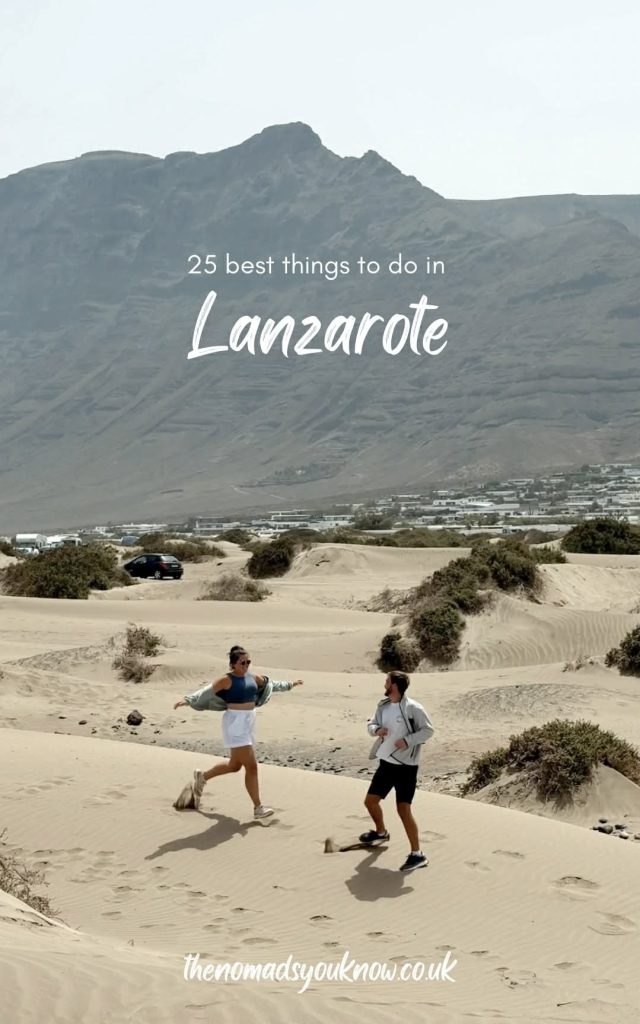
This is our favourite beach on the whole island! If you want drama, then Playa de Famara is for you. This beach is wild and far from the tourist trail. it is lined on one side by the Risco de Famara, a beautiful stretch of cliffs and at the base a wide beach with sand dunes, all of which make this beach so picturesque.
Playa de Famara is also the perfect place to learn how to surf. There are many surf schools that operate out of the town, Caleta de Famara. Plus, if you want to surf on your own, you can just rent a board for the day. The cost is 20 Euros in most shops. We also recommend that you visit the beach at sunset, as on a clear day you will get a stunning glow reflecting off the mountains, it becomes a truly magical setting.
It is worth knowing that this beach can get fairly windy, especially during winter. If the wind is blowing, it is best to avoid, as gusts can be so strong in this area that it almost knocks you off your feet. You can find parking along the main beach road, also be aware that there is often sand on the road, so take care.
18. Parque Natural de Los Volcanes
As it is forbidden to hike within the Timanfaya National Park, the smaller Parque Natural de Los Volcanes is a brilliant alternative only right next door. In this area you are permitted to hike on the marked trails, such as to the Volcan el Cuervo crater.
This is a short 30-minute loop that takes you right inside the crater of a volcano, for an up-close look at the formations and flora growing inside. It is a really unique walk that will offer some of the best views on the island. What makes this hike one of the most accessible in the area, is that it is flat and requires and has no incline. Nearby, there are other volcanoes that you can summit too such as: Caldera Colorada and Montana Los Rodeos.
However, even if you aren’t much of a hiker, the drive alone through this park is otherworldly and really showcases Lanzarote’s volcanic landscape. There are various layby’s that you can pull into and take photos.
19. La Corona Volcano
La Corona is located in the north of Lanzarote and is another great option for a short hike, with a great reward. If you navigate to the village of Ye, you can park at the church and then start your hike from there, the hike will take roughly 30 minutes one way. We mentioned this volcano previously as the underground lava rivers at Cuevos de los Verdes, connect to this extinct volcano.
This hike will take you to the crater rim at a height of 609m. From the rim you will have sweeping views across the northern tip of Lanzarote from east to west, it is really breath taking and well worth it. You could combine this hike with a visit to any of the following too: Arrieta, Punta Mujeres, Cuevos de los Verdes, Mirador del Rio/Guinate or Jameos del Agua, as they are all very close by.
20. Valle de Malpaso
Valle de Malpaso is a free viewpoint with a glass observation deck that sits high above the valley that weaves its way down the mountains and towards the small village of Haria. It is definitely a hidden gem! From here you will get extraordinary views down towards Haria and across Lanzarote’s hill country. This is the greenest part of the island, due to it receiving the most rainfall, which makes a refreshing change to the otherwise arid landscape of the island.
21. Los Hervideros
Los Hervideros on the Southwest coast of Lanzarote, is a unique viewpoint that requires no hiking to reach. In fact, you can park and step outside your car and then you are already there. This area is made up of a set of cliffs that were formed by the erosion of volcanic rock, as a result of the crashing waves below. The waves splash into the underwater caves and increase the water level, which creates the illusion that the water is boiling. It is a really cool spot to watch this phenomenon and has a beautiful setting with the bright red Volcan Bermeja in the distance.
22. El Golfo
Only a short drive away, on the same coastline you will find the village of El Golfo, which offers another extremely unique viewpoint and natural phenomenon. This village is well-known for its bright green lagoon. The beach and cliff tops that are home to this green lagoon are actually the remnants of a volcanic cone. However, after the last eruptions of Timanfaya in the 1700s, the crater collapsed and became partially submerged by the ocean. The sea flooded the crater and created the green lagoon that is now cut off from the ocean.
There is a very short walk (5 minutes) to the viewpoint, from the car park. You used to be able to walk along the beach, but the cliffs have become unstable, so access is now restricted to the viewpoint. Moreover, it is definitely worth checking out the village of El Golfo, as it is really charming, with seafront restaurants and a beautiful coastal walk into the lava fields.
23. Monumento al Campesino
Monumento al Campesino is another one of Cesar Manrique’s creations, a structure that sits at the geographical centre of Lanzarote as a dedication to farming industry on the island. But not only that, the venue has been made into a photographer’s heaven, with stunning whitewashed buildings, volcanic staircases and a very Canarian cafe. It is free to visit, if you are passing by, we definitely recommend that you stop in to enjoy the architecture and take some photos.
24. Mirador de Acercamiento
This is Lanzarote’s very own plane spotting viewpoint! Situated at the end of the runway Mirador de Acercamiento, is a great spot to watch the planes as they land on the island. You will be stood directly underneath the planes and feel the roar as they glide above your head, only metres above. You can reach this spot by walking from either Playa Honda or Matagorda, along the coastal path. This is a quirky and unexpected fun place to visit in Lanzarote and makes for some great photos and videos too.
25. Salinas de Janubio
Did you know that Lanzarote produces its own salt? Well now you do, and you can actually visit the site where all the production happens. Salinas de Janubio are the salt flats of the island and are the largest in the Canaries. On a visit here you can watch the workers mining the salt and even take a tour amongst the flats to touch the salt yourself. Moreover, there is a restaurant with views out across the salt flats and a viewpoint from the cliffs above, that offers a unique vantage point.
Final thoughts on Lanzarote
This island is truly special and has something for everyone to enjoy. We really hope that you get the opportunity to experience the unique way of life here in Lanzarote and tick off some of the spots mentioned in this guide. If we have inspired, you to visit or helped you plan your trip the do let us know. If you’d like more Lanzarote inspiration, then be sure to follow us on Instagram, where we share many more tips and inspiration.


What a great overview! I think I might go there. ????
Get that house bought haha!!
Looks beautiful Lyds. Can’t wait to go and experience what you love about the island
Thanks Rach, its an incredible island!